
By MIKE WILEY, Publisher —
The bond measure, which would have hiked local property taxes, was defeated by an overwhelming margin —
In the November 4 Special Election, voters in the Oregon Trail School District decisively rejected a proposed $172.2 million infrastructure bond, handing district officials a sharp defeat and complicating plans for long-planned upgrades to aging school facilities. With final tallies showing roughly 72 percent opposed and 28 percent in favor, the “no” vote indicted deep community unease over another large spending effort.
What the bond funded
The bond, placed on the November 4 special-election ballot, was set to raise the district’s property-tax rate by a significant $1.12 per thousand of assessed value, from approximately $1.66 to $2.78 — translating, by the district’s estimates, into about $323 per year for a homeowner with a typical assessed value of $288,000.
According to the district, bond revenues would have financed a wide array of facility improvements across the district’s schools — replacing aging mechanical systems; upgrading roofs, electrical, plumbing, and HVAC; converting portable classrooms to permanent classroom spaces at schools such as Kelso, Naas, and Boring Middle; renovating cafeterias and gymnasiums at Firwood, Naas, and Welches elementary schools; improving playgrounds, athletic fields, and recreation facilities; and enhancing accessibility and building safety.
Supporters argued the bond was critical to ensure long-term facility sustainability, equal educational opportunity, and a safe, orderly learning environment. District materials emphasized that many campuses rely on outdated modular classrooms or lack core spaces like gyms or cafeterias.
A secondary benefit: the district stood to receive a $6.1 million state matching grant through the Oregon School Capital Improvement Matching (OSCIM) Grant Program — supplemental funds contingent on local bond approval.
Still, voters decisively rejected the proposed measure.
The long shadow of the 2008 high school bond
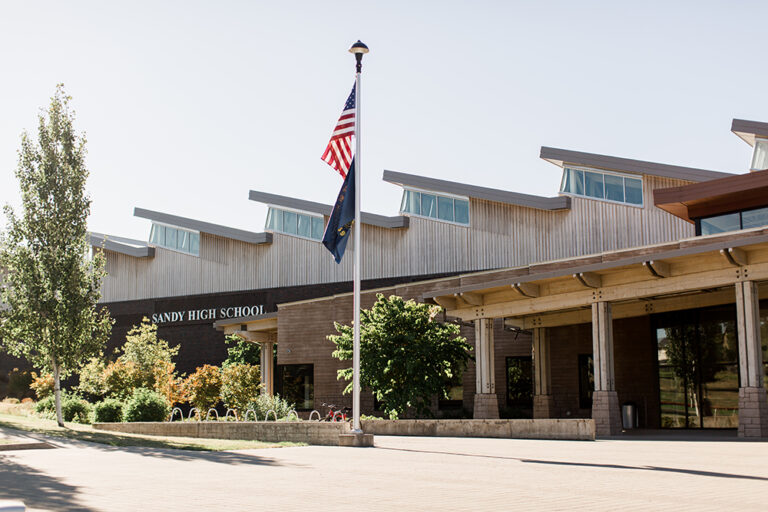
To understand the strong resistance to this measure, it helps to look back to the district’s last major bond vote in 2008. That bond, then totaling $114.9 million, funded construction of a new high school — Sandy High School — and upgrades across the district, including security enhancements, roof repairs, HVAC improvements, and installation of WiFi, updated phone systems, card-access entry, security cameras, and single-entry vestibules.
Sandy High opened in 2012 as a modern campus with 306,000 square feet, career- and technical-education (CTE) facilities, athletic fields, and upgraded security infrastructure. The bond also was supposed to enable the district to expand programs, repair or replace aging roofs and HVAC systems, and fund other improvements such as turf-field installation, track replacement, and additional classrooms at Naas Elementary to accommodate enrollment growth.
Many remained concerned
Despite those investments, many in the community remained concerned. Some felt the cost had not delivered sufficient returns — citing, for example, reported underutilization of portions of the Sandy High School facility or failure to prevent subsequent needs for repairs or upgrades in other district buildings. The district acknowledged that, while the former Sandy High building had been remodeled, other district school campuses still suffered from aging systems, modular classrooms, inefficient buildings, and lack of gyms, cafeterias, and safe recreation spaces.
With that history, many taxpayers viewed another steep tax hike with additional concern — especially as it came during a time when cost-of-living pressures are already acute.
Results: a firm ìNoî
As ballots were tallied on Nov. 4, the result quickly became apparent: voters delivered a firm rejection. According to county election returns, the bond failed with 6,473 votes against and 2,552 in favor — roughly 72 percent “No,” 28 percent “Yes.”
The resulting vote tallies were described as “overwhelming,” reflecting widespread opposition across the Sandy-area communities served by the district.
With the defeat, the district loses access to the state OSCIM matching funds. That means immediate plans for comprehensive upgrades and replacement of portable buildings, renovated gyms, cafeterias, and athletic-field improvements will likely be shelved — or require a rethinking around smaller-scale repairs funded from the operating budget or deferred for an indefinite future.
What happens now?
District leaders must now confront the reality that without the bond funding, problems such as aging roofs or HVAC failures, leaky plumbing, outdated classrooms, and insufficient recreation/common spaces will require different solutions.
The decisive rejection by voters sends a clear message: after the major 2008 investment, community appetite for further large-scale bond measures has declined. High taxes — and lingering doubts about whether past investments delivered proportionate value — loomed larger than potential facility improvements.
With the bond failure, smaller-scale repairs or incremental funding via the district’s Facility Improvement Fund may have to be reconsidered. A future bond may also be attempted — but likely only after a more thorough community engagement process and perhaps a pared-down set of priorities. However, the decisive nature of the voters rejection of this bond measure suggest that even that smaller proposals may face strong voter headwinds.
Further, public schools in general have been facing a growing sense of alienation from large sections of the population that has grown skeptical of many aspects of modern education. Oregon has seen test scores decline and its national rankings plummet in recent years.
For now, however, the 2025 rejection leaves many of the district’s aging buildings in limbo — and raises tough questions for administrators about how to ensure safe, modern, and equitable learning environments without further stressing taxpayers who seem to feel tapped-out. HVN