
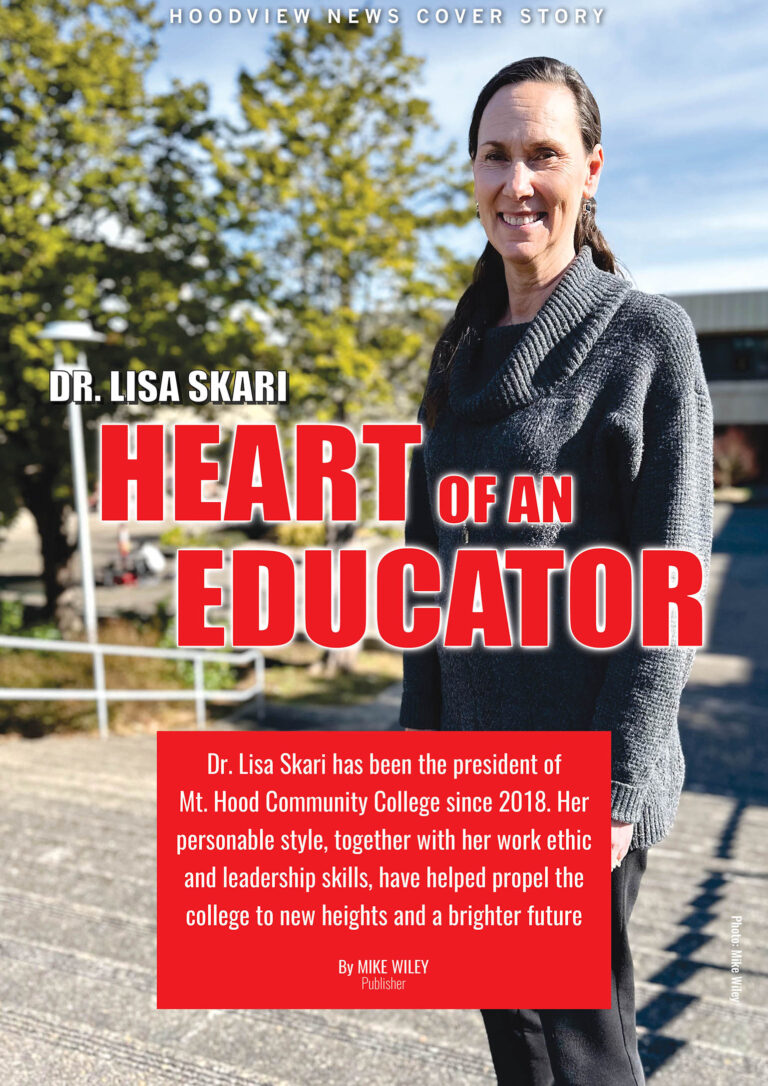
Mt. Hood Community College has over 14,000 students, but it still seems personal, intimate. College President Lisa Skari has helped make it that way.
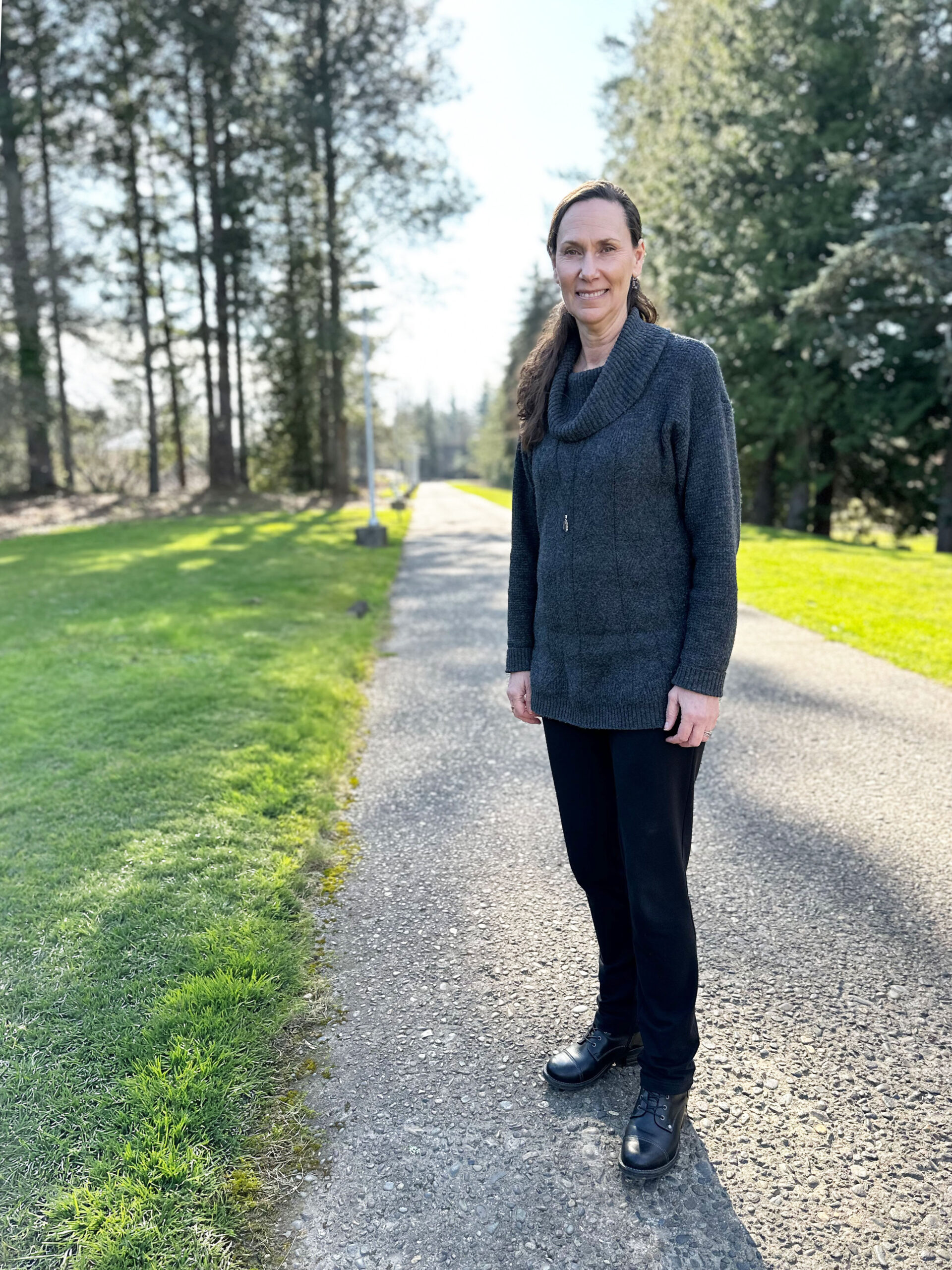
On a recent, unusually bright and warm winter day, Lisa Skari was dressed in a light sweater and slacks. She walked across the campus and down the concrete outdoor corridors that direct the flow of students to and from their various classes and destinations. As she passed students, they greeted her with nods and quiet “Hello’s” that signaled both recognition and warmth. It’s clear that they know her. They respect her. They trust her. Her approachable, friendly manner has helped make the “brutalist” architecture of the 1970s-era concrete structure into a warm and welcoming place for local students to learn, grow, and become. Her talent for administration and her commitment to community involvement has helped the college to survive trying times and to now have a bright future ahead of it.
“I have the best job,” Skari said.
“I love what I do, and that’s because of the ability to have impact. I believe in education, but also I’ve always been driven to have an impact and in ways that I can be of service and help others out. That’s what’s personally gratifying for me.”
For Skari, that sense of purpose is not abstract. It has shaped every major decision in her professional life — from her early career choices to her leadership philosophy today.
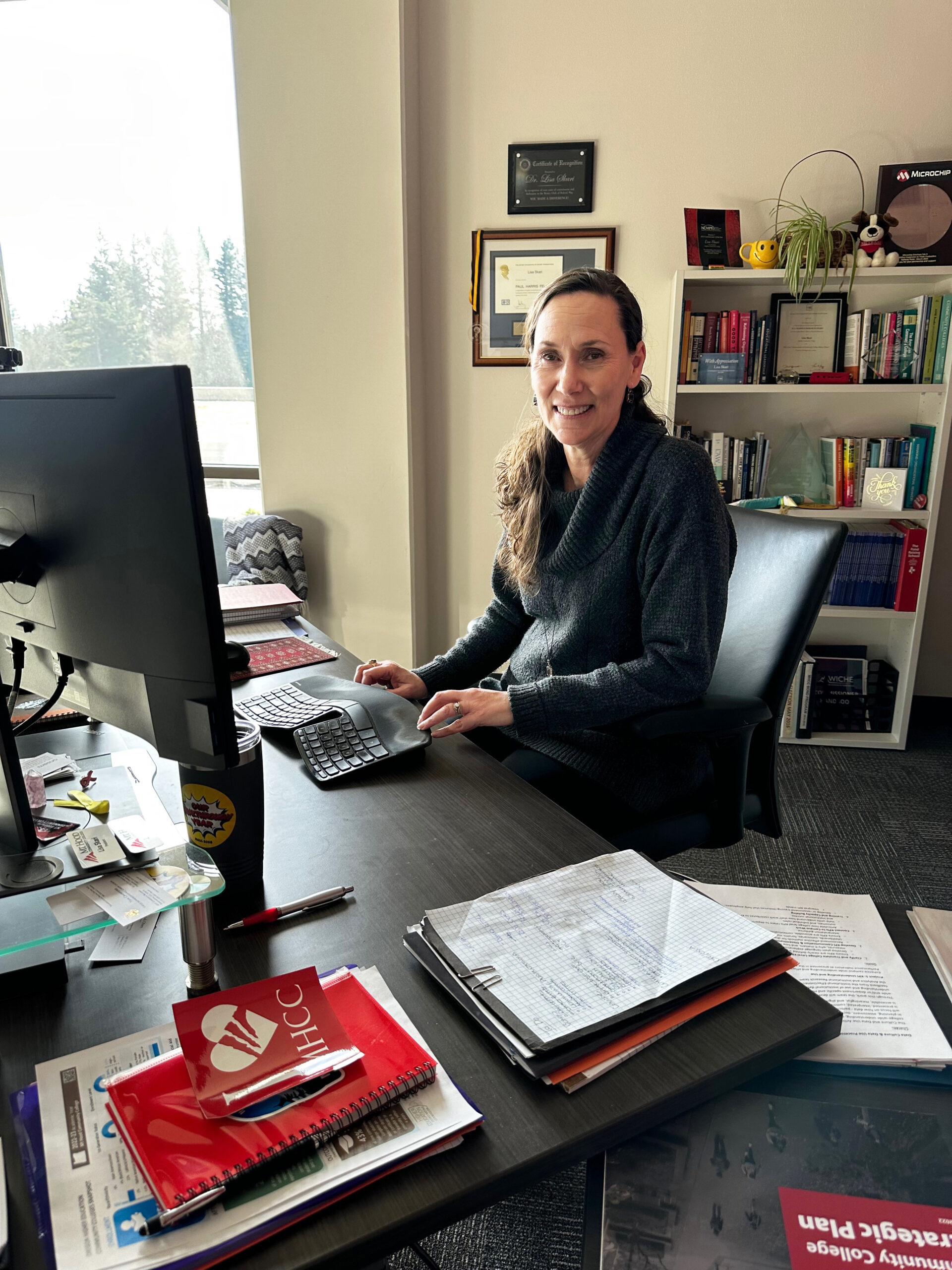
It also explains why, after more than three decades in the community college education field, she still speaks with passion about her calling.
A path unforeseen
Lisa Skari did not begin her life expecting to lead a major public institution.
She spent her earliest years in north-central Montana, in a rural setting about 17 miles from the nearest town. “I spent the first seven years of my life on a wheat and cattle ranch in north central Montana,” she said.
Her father died when she was six. “After my dad passed, we moved to Missoula, and so that’s where I grew up through high school,” she explained.
After that, her life followed a fairly typical path for a young woman preparing for a professional career. Education was valued in her family, but she did not initially see herself working in the education field. In fact, she intended to avoid it entirely.
“In high school, I didn’t know what I wanted to do,” she said. “But the two things I didn’t want to do were education or politics.” Instead, she pursued business — a decision that would eventually, and somewhat unexpectedly, lead her back toward the very field she had once intended to avoid.
Finding her calling
After high school, Skari attended Washington State University, earning a business degree before continuing to gain her MBA at Pacific Lutheran University near Tacoma.
After college, her first career foray was in retail management — a field that seemed to offer opportunity and advancement. Her goal was to become a buyer for a department store, and she succeeded in reaching that position. A retail buyer is the person responsible for selecting and purchasing the merchandise a store will sell, balancing customer demand, trends, pricing, and profitability.
But the experience quickly proved disappointing.
“I got hired after graduation with a department store and got to the buying office,” she recalled. “And hated it.” She spent the next several years reconsidering her direction, eventually returning to graduate school. To help support herself, she worked as a teaching assistant — an experience that quietly reshaped her outlook.
“I enjoyed being a teaching assistant, but still hadn’t really thought of it as a career path,” she said.
Then came the moment that changed everything.
While searching job listings in a newspaper she noticed a short advertisement seeking someone qualified to teach retail management at a community college.
“There was a three-line ad in the local newspaper,” she said. “The local community college was looking for someone who could teach retail management… and I thought, ‘Wow, I’m actually qualified to do this.’”
She applied and was hired — and soon discovered a passion for education that she had never anticipated.
“Probably in the first couple of weeks of teaching, I’m saying to myself that this is where I want to be,” she said. “I love the students. I love the environment.” What resonated deep with her was the mission of community colleges themselves.
“What I love about community colleges is they were designed to be open access institutions,” she explained. “So anybody who wants to come here has the ability.”
That principle — accessibility combined with opportunity — would become the foundation of her career.
A career takes shape
Skari’s first teaching role did more than confirm her interest in education — it opened doors she had not anticipated.
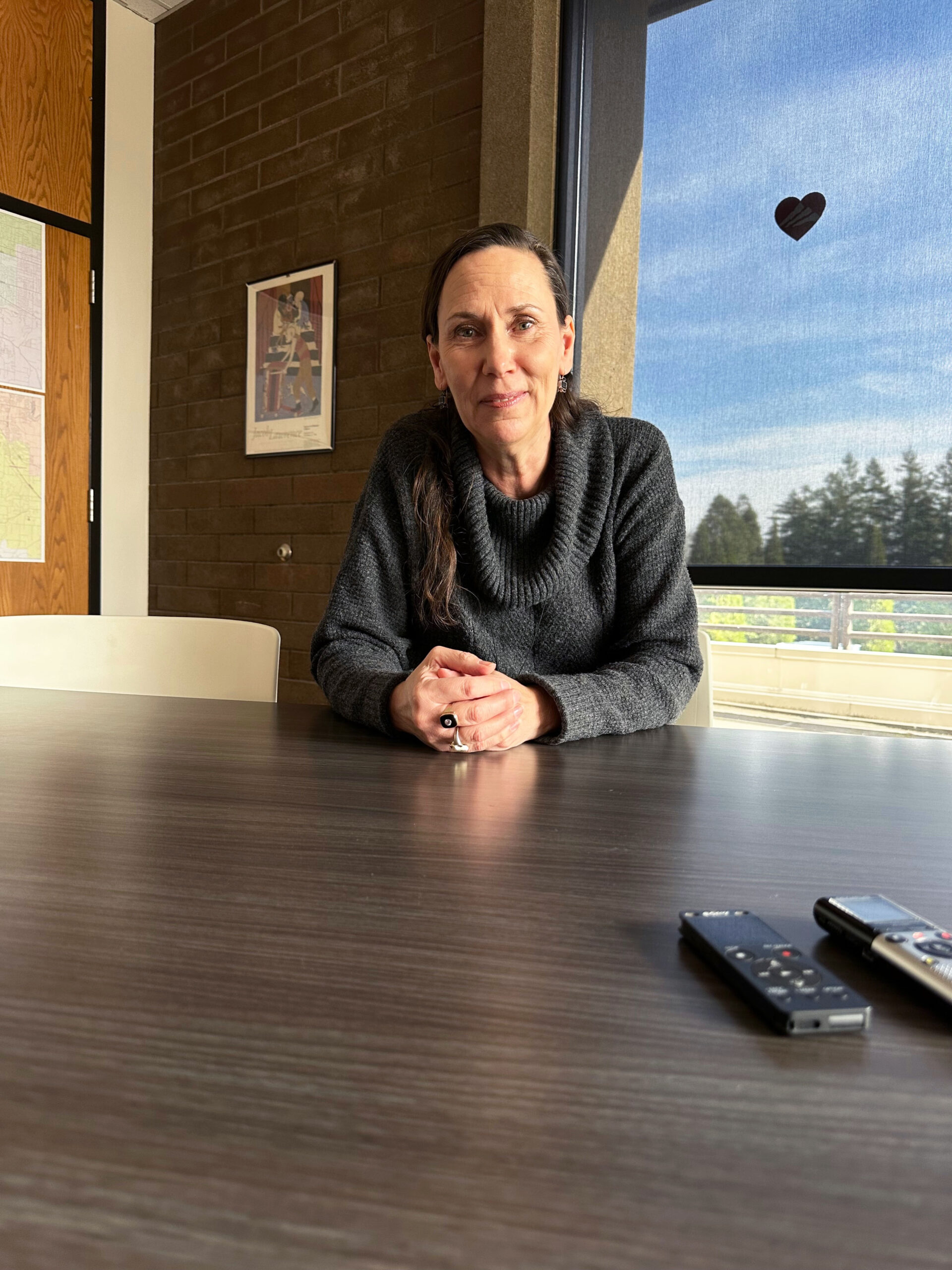
Like many early-career educators, she initially expected to remain on a traditional faculty path focused on teaching in the classroom. But timing and circumstance soon led her toward the administrative path, a path where her organizational skills and private-sector experience quickly proved particularly valuable.
Unfortunately, at the time, hiring freezes were limiting new faculty positions within the Washington state community college system. However, federal grant funding was an alternative source of revenue that schools could use to staff new positions. One of these grants created an opportunity to launch an internship program designed to connect students with paying work experience.
Skari applied for the role — and received it. She quickly found that her background in business allowed her to build bridges between employers and the college.
“I think that was one of my assets,” she said. “Coming out of private industry, I didn’t speak ‘education’ — I spoke ‘business.’
That ability made collaboration easier and helped create new opportunities for students. “I worked with employers,” she explained, “and it made it very easy to talk to them about what students needed and how we could support that.”
Over time, her responsibilities expanded. A mentor encouraged her to take on oversight of instructional budgeting. It was a role she initially resisted. “I told him I didn’t want to do it because I didn’t want to do numbers,” she said with a laugh.
But, she dove in anyway and the experience proved more valuable than she anticipated. “I learned how the whole budgeting process works and how large public funds operate,” she said. That knowledge would later become important in her leadership career.
Leadership Highline College
Highline College, just south of Seattle near the Sea-Tac airport, serves a large and remarkably diverse student body drawn from the surrounding Seattle-area communities. It was there that Skari would spend the next 25 years building her career, steadily advancing through administrative roles. After overseeing instructional budgets, she became Vice President for Advancement — a position she held for 17 years.
The role required managing a wide range of off-campus functions. “It’s everything that happens related to the college that doesn’t happen on campus,” she explained. “Student recruitment, marketing, public relations, government relations, grants.”
She also served as executive director of the college’s foundation, further expanding her experience in fundraising and community engagement. During those years, she developed the leadership style that colleagues and community leaders now frequently praise: collaborative, personable, and deeply community-oriented.
Yet, even as her responsibilities grew, she did not initially aspire to become a college president.
“Part of my commitment… I said I never wanted to be a college president,” she said. There were personal reasons for that decision as well. As a single mother, she prioritized stability and family.
“I had made a commitment to not do anything until my daughter was off to college,” she explained. But as her daughter approached graduation and leadership transitions occurred at Highline, Skari began to reconsider her future.
“I felt like I’d done most of what I could do as a VP,” she said. “And I started thinking about where I could have more impact.”
Choosing Mt. Hood Community College
When she began exploring opportunities to be a college president, Skari was selective. She applied to only three colleges — all institutions where she believed her experience aligned with their needs.
Mt. Hood Community College stood out for several reasons. “What attracted me to Mt. Hood specifically was its very diverse and broad student body,” she said.
She also saw strong potential in the region’s business partnerships. “It’s got a strong business space,” she explained, “because if you have strong local employers, that’s great for a community college.”
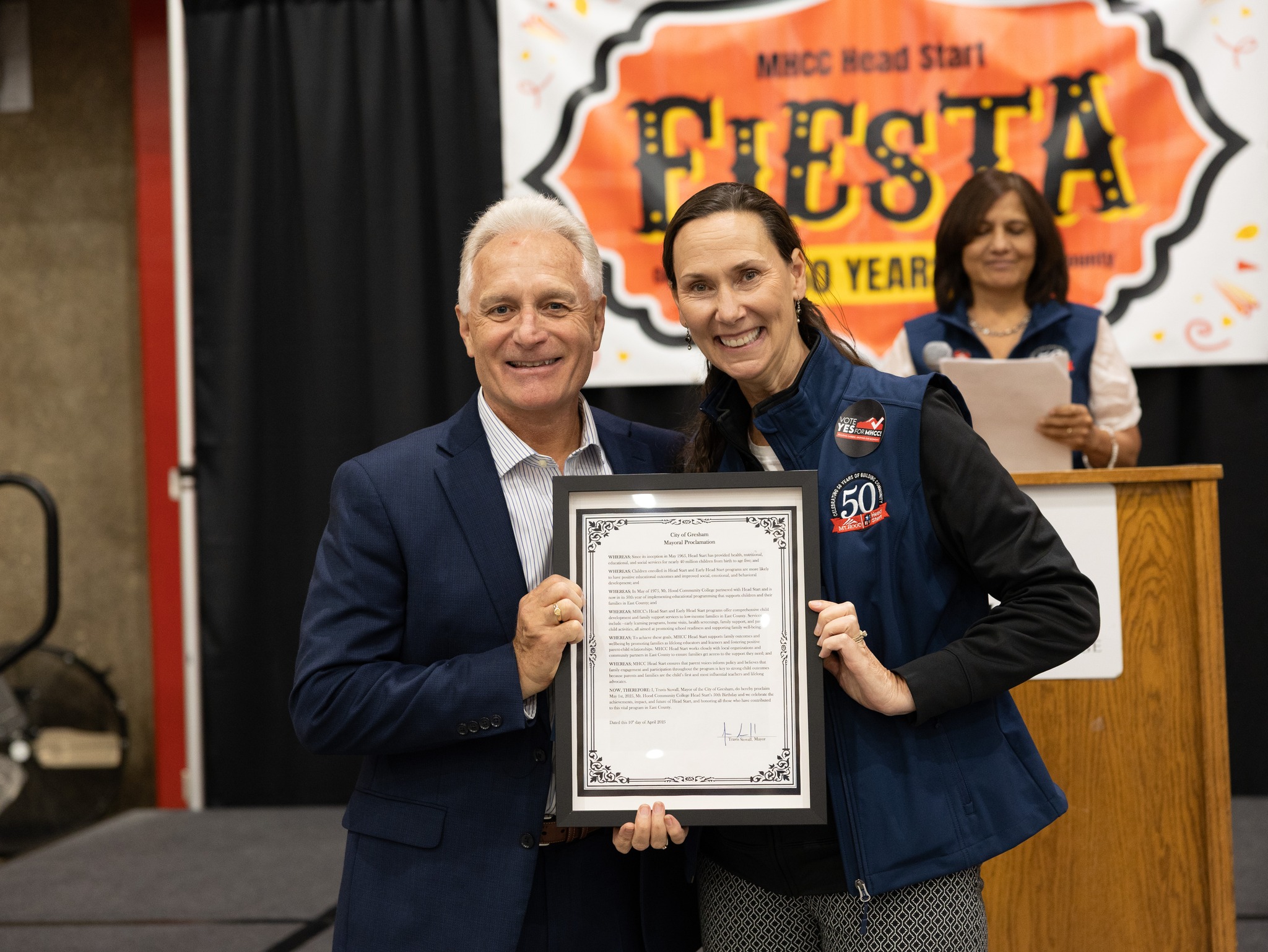
(Image from Facebook)
The hiring process was led by a committee from the Mt. Hood board. It began in the second half of 2017. It was lengthy and thorough, lasting nearly six months and involving multiple rounds of interviews and community input. She was officially offered the position as president by the board in 2018, which she accepted. However, significant challenges awaited.
Early challenges: Stabilizing the college
Shortly after her arrival, Skari discovered the college faced a serious financial challenge — not enough income to cover expenses. This meant that the college’s built-in costs were consistently higher than its steady income — a long-term imbalance that inevitably requires painful cuts or new revenue to correct. “We had a structural deficit,” she said. “We were spending more than we took in.”
Addressing the situation required difficult decisions, including program reviews and budget reductions. “That’s always hard,” she acknowledged. “Anything you do impacts people.” Despite the difficulty, the process ultimately helped stabilize Mt. Hood’s finances and create a more sustainable foundation for future growth.
Then, just as those efforts were beginning to make a difference, another wholly unforeseen crisis arrived. In early 2020, the COVID-19 pandemic forced the campus to close.
“I figured being 17 years as a vice president, I’d seen everything,” she said. “I had no idea I had to know anything about public health.” Like other colleges nationwide, MHCC shifted rapidly to online learning while maintaining essential programs in healthcare and career technical education (CTE).
The experience was discouraging and exhausting for Skari — but it also reinforced her commitment to the institution’s mission. Over time, students returned, campus life resumed, and enrollment gradually rebounded. Today, Skari says the campus once again feels vibrant. “This year has been great,” she said. “There’s tons of student clubs, and it feels normal again.”
Building community trust
When Skari arrived at Mt. Hood Community College in 2018, she brought with her extensive experience in community engagement — but she quickly realized just how essential that skill would be.
The college’s financial challenges were only one part of the picture. Equally important was rebuilding confidence and connection with the local communities that the college serves across East Multnomah, Clackamas, and Hood River counties.
Skari understood early that community colleges succeed only when they are closely tied to the people around them. “I truly believe that we’re a community college, and our requirement is to be serving our community,” she said.
That philosophy shaped her leadership from the beginning. Rather than focusing solely on internal operations, she emphasized visibility, accessibility, and listening — ensuring that residents, businesses, and local leaders saw the college as a shared resource. Her approach reflected lessons learned over decades of experience.
“If you have strong employers, that’s great for a community college,” she explained, “because then you can build up their workforce and partner with them.” That emphasis on partnerships would soon become crucial as the college prepared to pursue something it had not successfully achieved in more than half a century.
Passing a once-in-a-generation bond
By the early 2020s, it was clear that Mt. Hood Community College’s facilities — many built in the 1970s — required significant modernization and safety upgrades.
Previous bond measures had failed multiple times over the decades. The last bond that passed was in 1974, shortly after the college’s founding in 1966. Previous attempts in 2002, 2006, 2016, and 2017 all failed, often by large margins.
Skepticism about the chance for a new bond measure’s success lingered within the community, and many long-time employees remained cautious about the prospects for success.
Skari understood the emotional weight of that history. “This was the seventh [overall] attempt,” she said. “You could see people who had been here a long time were supportive, but a little guarded because they had tried before and it didn’t pass.”
From the outset, she framed the effort not simply as a funding campaign, but as an opportunity to strengthen trust. “People [in the community] had told us, ‘You only come to us when you want money,’” she recalled. “So we needed to change that.”
Under her leadership, this time the college engaged deeply with residents, gathering feedback from hundreds of community members and refining the proposal to address local priorities. The result was Measure 26-258 — a $136 million bond focused on modernizing infrastructure, expanding workforce training facilities, and improving campus safety.
In May 2025, after decades of unsuccessful attempts, the measure passed by an extraordinarily narrow margin — just 131 votes out of more than 40,000 cast. For Skari, the victory represented more than financial support.
In a statement reported by KATU, she said, “We are profoundly grateful to our community for this vote of confidence,” she said at the time. “This victory belongs to every student, volunteer, and community member who believed in our vision.”
Yet she views the outcome not as an endpoint, but as a new beginning. “This is truly the beginning,” she said. “We need to continue the community engagement and expand it.”
Sue O’Halloran is the principal broker at KMO Real Estate in Gresham and knows Skari well. “In her role as President of Mt. Hood Community College, Lisa has been instrumental in bringing the college to the forefront in our East County community relationships. She shows up at all sorts of events and activities, always in a listening mode with a smile on her face,” said O’Halloran.
Leadership by collaboration
Skari’s colleagues also consistently describe her leadership style as collaborative, steady, and deeply relational.
Jeff Wagnitz, who worked with her at Highline College, remembers her as both optimistic and pragmatic. “Lisa brought endless positive energy and optimism to the job,” he said. “Even when times were tough, she remained a true believer in the college’s mission, people, and potential.”
At the same time, he noted, she never avoided difficult challenges. “She was a reliably creative, deliberate thought-partner on every issue, big or small.”
That combination of warmth and strategic focus has been especially evident in her community outreach work. “She always loved being out in the community or inviting the community in,” Wagnitz said. “Part of her secret was her genuine warmth.”
Today, local leaders also credit her engagement with helping build support for the bond measure. Diane McKeel, former Multnomah County Commissioner and MHCC Board member, described her role in the bond’s success as pivotal.
“She has exceptional leadership skills and community involvement,” McKeel said. “Both were instrumental in the passage of the MHCC bond — the first in 50 years.”
Business leaders echoed that view. “Dr. Skari understood that for people to vote for a bond, the college had to be seen as a strong part of the community,” said Bess Wills, CEO of Gresham Ford. “She worked to make that happen.”
At the state level, her influence has also been recognized. “Lisa built trust across the community,” said Abby Lee of the Oregon Community College Association. “She communicated clearly, listened deeply, and helped people see what was possible for the future of MHCC.”
Preparing students
Today, as Mt. Hood Community College moves beyond the disruptions of the past decade, Skari’s focus is increasingly centered on the future — particularly how the college can best prepare students for meaningful careers.
For her, the mission of a community college is both simple and deeply practical. “I truly believe that we’re a community college, and our requirement is to be serving our community,” she said.
That service, she emphasizes, is closely tied to workforce opportunity. “I feel like that emphasis is also tied to jobs and careers,” she explained. “How are we making sure that people who come here get skills that they can use down the road — that their time here and their money spent is leading to something that will benefit them financially or give them options in the future?”
Partnerships with regional employers play a central role in that vision. The college has worked closely with major semiconductor companies in the district, including Microchip and On Semiconductor, to create pathways that connect education directly to employment.
“It’s been fun to see that awareness,” Skari said, noting how some employers have begun covering tuition costs upfront to encourage employees to continue their education. Such collaborations reflect a broader goal: ensuring that students leave the college not only with knowledge, but with real-world opportunity.
A vital economic engine
The impact of Mt. Hood Community College extends far beyond its campus boundaries. Each year, the college contributes hundreds of millions of dollars to the regional economy through workforce training, business development support, and student employment outcomes.
Alumni working in the region add more than $350 million annually in economic activity, helping sustain local businesses and industries. Overall, the college generates an estimated $423 million in total economic impact and supports nearly 4,900 jobs across East County.
For Skari, however, those numbers represent something more personal than economic statistics. They reflect the individual lives changed through education. That perspective is one reason she remains deeply committed to the open-access mission that first drew her to community colleges decades ago.
Leadership rooted in service
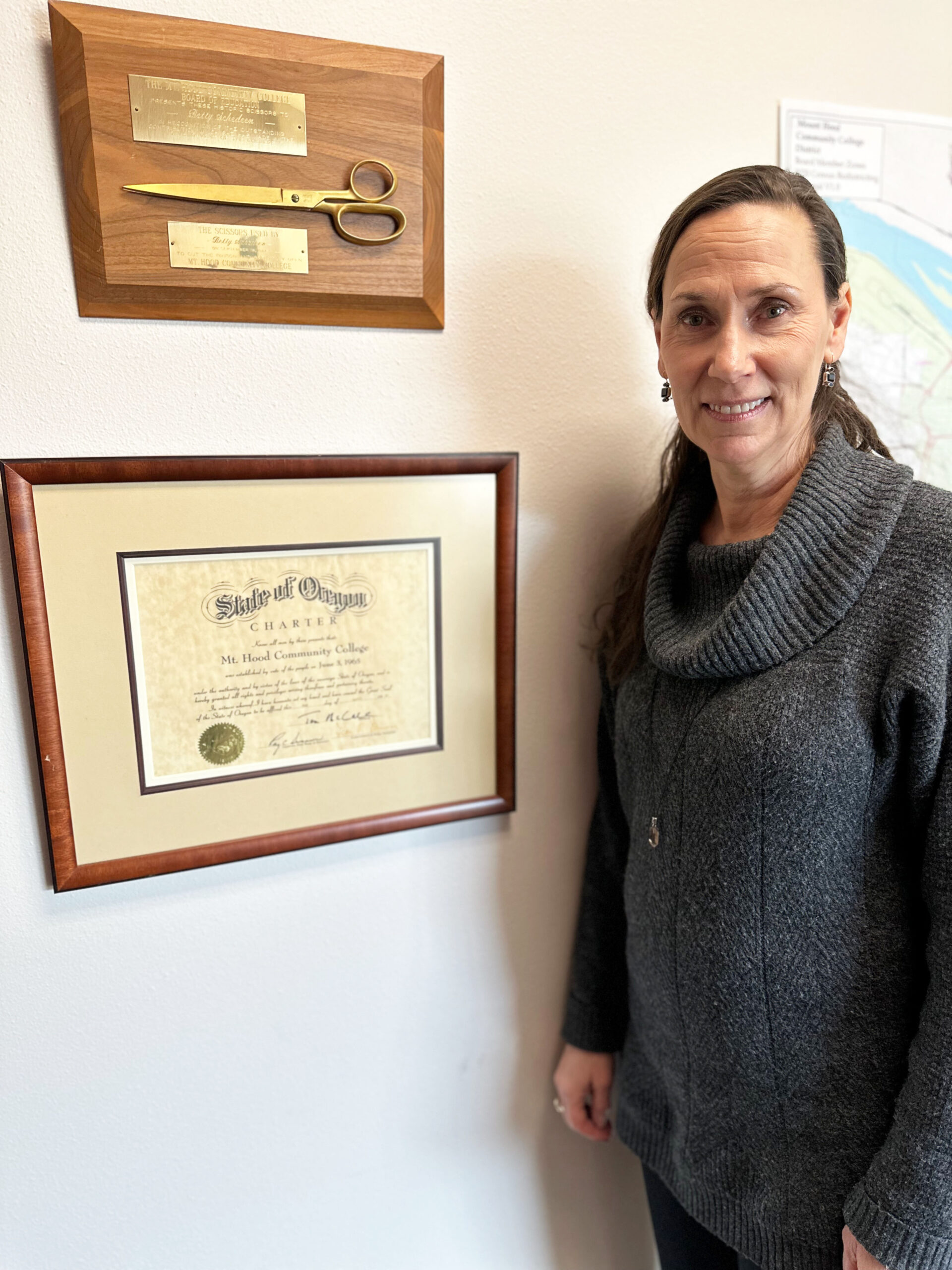
Colleagues frequently describe Skari as both strategic and approachable — a combination that has earned her recognition across Oregon’s higher education system. In 2024, she received the Outstanding Administrator Award from the Oregon Community College Association, an honor selected by her peers statewide.
According to Abby Lee, executive director of the association, the recognition reflected both her leadership ability and her personal qualities. “Lisa is one of those leaders who can be brilliant and strategic while also being warm, funny, and incredibly kind,” Lee said. “She elevates every room she’s in.”
Despite such accolades, Skari consistently redirects attention toward the collective work of faculty, staff, and community partners. That humility, observers say, is central to her effectiveness.
A life beyond the office
Though the demands of leading a major institution are considerable, Skari makes time for pursuits that reflect her lifelong connection to the outdoors. She and her husband live on a wooded property where she enjoys gardening — an activity she describes with characteristic simplicity. “I love to garden, plant, grow stuff,” she said.
In recent years, that hobby has taken on a community dimension. After consistently producing more vegetables than her family could use, she began donating the surplus to the campus food pantry. “We started donating to Barney’s Pantry,” she said. “Last year it was about 160 or 170 pounds of produce.” KMO’s Sue O’Halloran says, “Lisa is an amazing gardener who loves to grow any and every vegetable. Her garden is prolific.”
Looking ahead
When asked about her future, Skari’s answer is straightforward. “I plan to retire from here,” she said.
For now, her focus remains firmly on strengthening the college’s role within the community — expanding partnerships, supporting students, and ensuring the institution continues to evolve alongside the region it serves. That work, she believes, is ongoing.
The passage of the historic bond measure, she notes, was not an endpoint, but a starting point. “This is truly the beginning,” she said. “We need to continue the community engagement and expand it.”
On this bright winter afternoon, as Skari continued across campus, the steady flow of students reflected a renewed sense of normalcy — and possibility. Some hurried between classes, others gathered in small groups, conversations echoing across the concrete walkways. The scene offered a quiet reminder of the college’s enduring purpose. For Skari, moments like these affirm the meaning of her work.
Each student passing by represents a story still being written — a future still unfolding. And helping make those futures possible is, in her view, exactly why she chose this path so many years ago.
When she says, “I have the best job,” it reflects the love and passion she has brought as the President of Mt. Hood Community College. HVN