
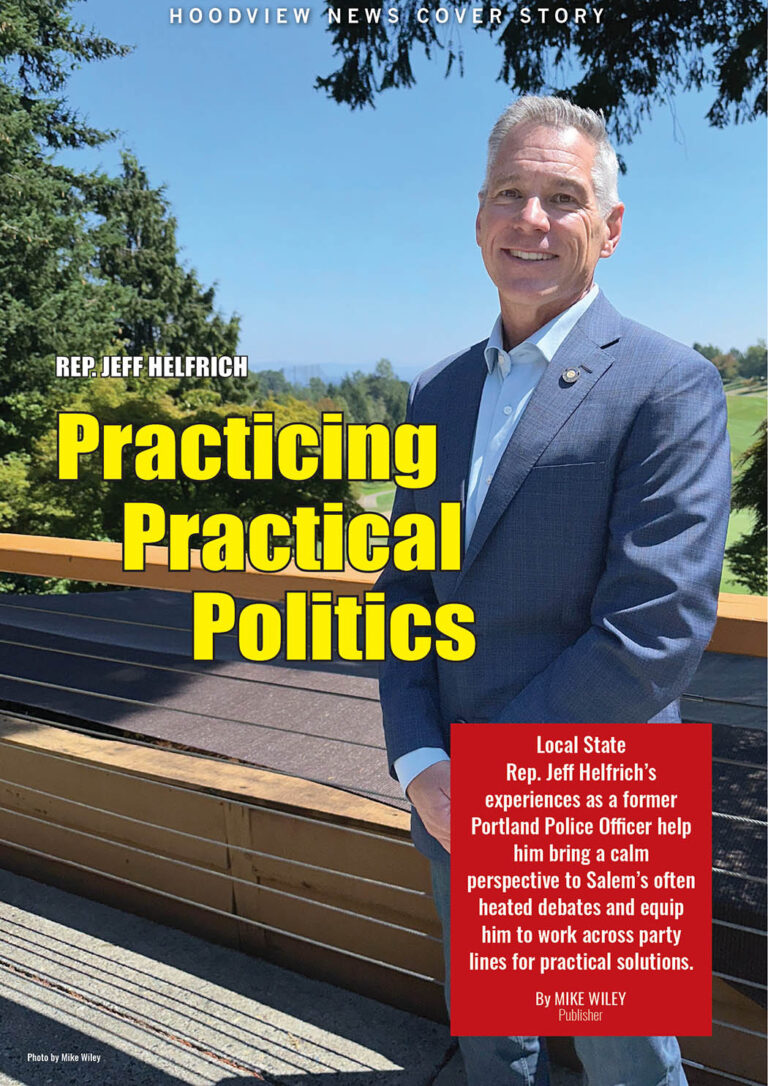
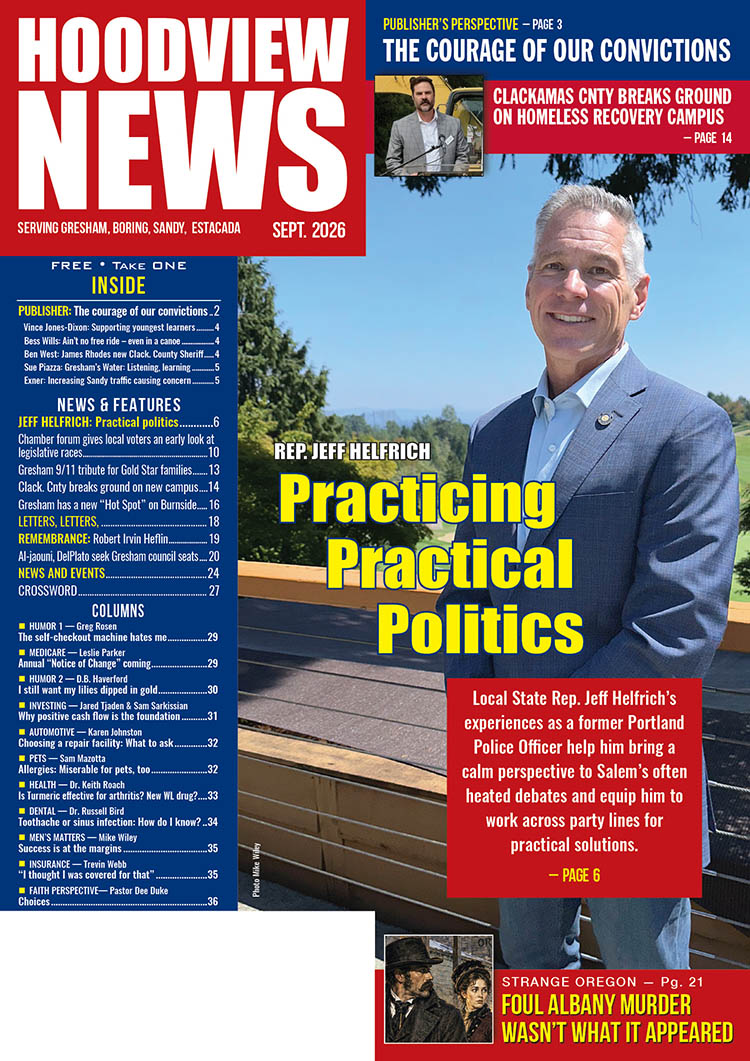
 Tempers get raised. Lawmakers dig into opposing positions. The stakes feel enormous, immediate. Then local State Rep. Jeff Helfrich, from the experience of more than two decades in the Portland Police Bureau, calmly puts things in perspective:
“There are no dead bodies.”
It isn’t the sort of thing most people expect to hear in the middle of a tense legislative debate, but the emotions of legislators in Salem grow calm as lawmakers understand the meaning. What they are doing is important, but not a crisis.
According to State Sen. Mike McLane, who has served alongside Helfrich for years, Helfrich’s timely observation has a remarkable effect. It brought perspective in a tense moment.
“It’s that cop humor,” McLane said. “He just has this way of de-escalating when people get tense… Jeff will say, ‘Hey, you guys, we’re here legislating. Everyone’s advocating for their district.’ He reminds people — we’re not in emergency rooms. We’re not cops in tough situations. We’re not firefighters running into buildings.”
Moving up?
This year, Helfrich is seeking to move from the Oregon House of Representatives to the Oregon State Senate. He is running for Senate District 26, a seat that has been previously held by legislative stalwarts Chuck Thomsen, Daniel Bonham, and, currently, by Christine Drazan, all Republicans. This year Drazan is the Republican nominee for governor and is vacating the seat.
Perspective comes easily
For a police veteran like Jeff Helfrich, perspective comes easily. The difficult days in Salem are measured against nights spent answering emergency calls, confronting violent crime, facing tragedies, and making decisions where actual lives—not legislation—hung in the balance.
That perspective has become one of Helfrich’s defining characteristics. Friends describe him as steady under pressure, practical rather than ideological, and hard to rattle. Whether discussing a complicated piece of legislation or helping solve a neighborhood problem, they say he approaches issues much the same way he did as a police sergeant: identify the problem, figure out a solution, and get to work.
Long before he ever became House Republican leader, or helped negotiate bipartisan legislation, or launched a campaign for the Oregon Senate, he was a youth from Colorado with deep family roots in Nebraska, raised among veterans of World War II. He was taught that hard work was expected, not celebrated. Helfrich enlisted in the Air Force instead of going to college, became a military working dog handler during the Gulf War, and later built a career in law enforcement after being recruited to Oregon by the Portland Police Bureau.
Rural roots
Before the military, before police work and Salem, Jeff Helfrich’s worldview was shaped hundreds of miles away on the plains and farms of Nebraska.
Although he grew up outside Denver, Colorado, he often visited the family farms in nearby Nebraska where both of his parents had been raised. There were cattle to tend, wheat and corn to harvest, alfalfa to bale, fences to mend, and chores that simply had to be done.
“I grew up in Colorado while spending a lot of time on our family farms in Nebraska,” Helfrich recalled. “My mom and dad came from a family farm and ranch in Nebraska… That’s where I really learned hard work and what it means to be an American.”
Barbara Hosford, a neighbor and longtime friend, believes those early years still show through.
“I think because of his personality and his background, being a farm boy… work ethic is high,” she said. “He’s kind of a jack-of-all-trades kind of guy. He does a lot of hard work around his place.”
Helfrich graduated from Columbine High School in 1986. Years later, the school would become known around the world for reasons no one could have imagined.
When the Columbine shooting unfolded in 1999, Helfrich was already a Portland police officer. Watching the television coverage was unlike watching any other national tragedy. He recognized the hallways, the cafeteria and the library. Only a few years earlier, he had walked those same corridors during his ten-year class reunion after the school had been remodeled.
“It really brought it home,” he said. “Even though I was over a thousand miles away, it’s like I was literally just right there in that building.”
The experience reinforced something he had already learned growing up on the farm: life can change unexpectedly, and the things that matter most are the people closest to you.
 Military service and Bob Hope
For many young people, high school graduation marks the beginning of college.
Helfrich chose a different path, military service. “I didn’t go to college,” he said matter-of-factly. “I went in the Air Force. My diploma is my DD-214.” It wasn’t a decision made on impulse. The military had been woven into his life long before he ever put on a uniform. His father had served in the Colorado Air National Guard. Great-uncles and other relatives had fought in World War II. Stories of service were simply part of growing up.
“My family was very patriotic,” he said. “I got to be around the Greatest Generation with my great-uncles and my grandfather… Everybody who served in World War II and then the subsequent wars after that, and that’s kind of what led me into the military later.”
“Airplanes always fascinated me, and that’s kind of how I landed in the Air Force,” Helfrich added.
After spending a year in the delayed enlistment program following high school, he left for Lackland Air Force Base in Texas in the fall of 1987.
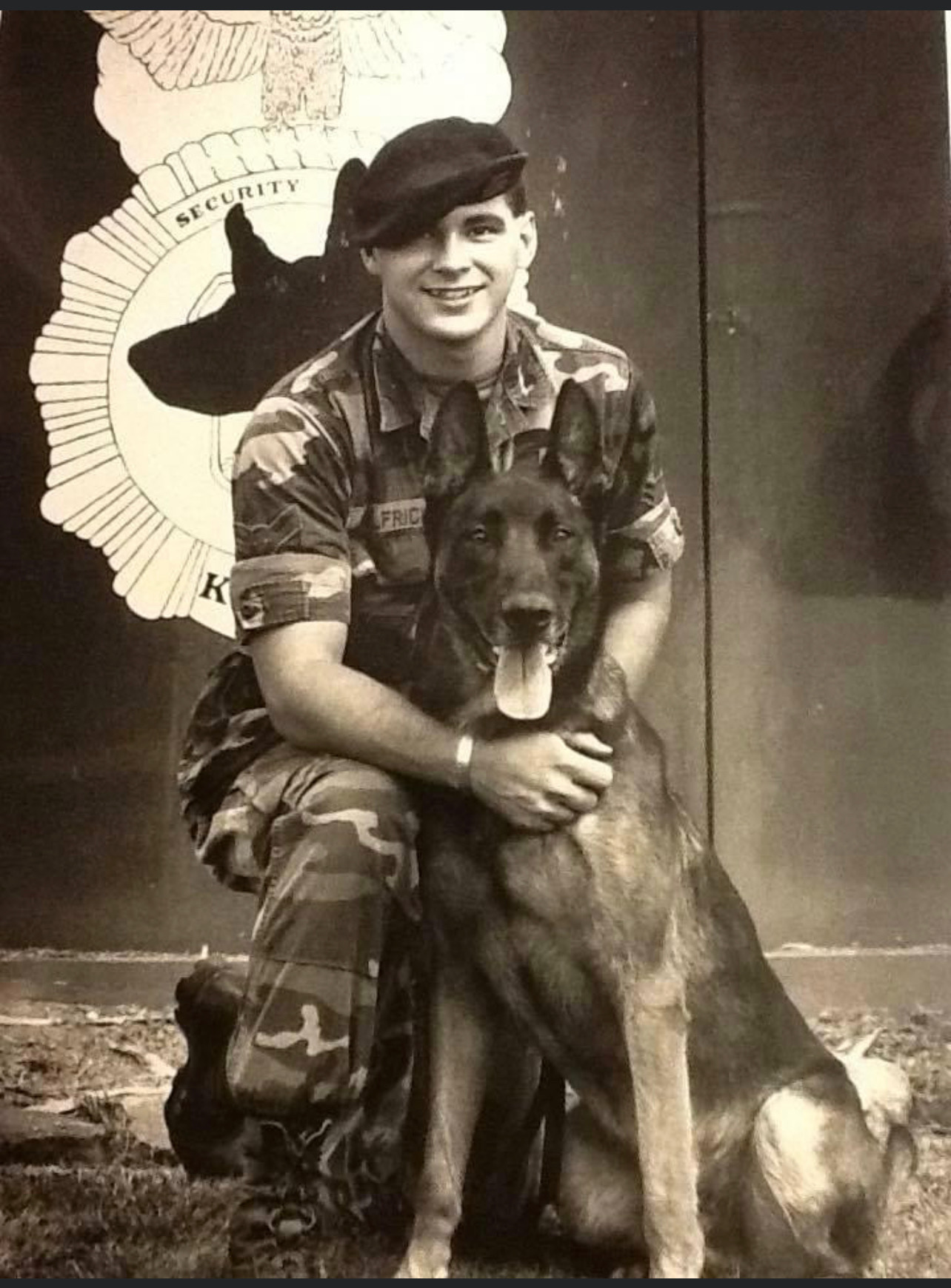
Although he had entered the Air Force with a guaranteed assignment, another opportunity caught his attention during basic training at Lackland. “I was watching the dog handlers down there,” he recalled. “I thought, ‘That’d be kind of a fun job,’ because I always liked hunting dogs.” He volunteered, eventually becoming a military law enforcement canine handler specializing in explosive detection. Instead of partnering with another airman, his closest working companion became a dog trained to detect bombs, weapons and ammunition.
The assignment brought responsibilities few young men his age would ever experience. During the First Gulf War, Helfrich served in Operation Desert Shield and Operation Desert Storm. His work also placed him on security details protecting presidents, foreign dignitaries and senior military leaders.
Yet when asked about the most memorable person he ever protected, he doesn’t mention a president. He mentions Bob Hope.
The legendary entertainer had traveled overseas for decades to perform for American troops. During the Gulf War Helfrich found himself assigned to Hope’s security detail.
“I remember growing up as a kid watching these reruns from World War II, from Korea and Vietnam,” Helfrich said. “I’m sitting here watching this guy entertain soldiers… I got to be with that guy. It was pretty cool.”
By the time his Air Force enlistment was ending, Helfrich already knew what he wanted to do next. “I knew I wanted to be a police officer,” he said.
Then, almost by chance, Oregon entered the picture. During the week he was processing out of the Air Force, a recruiter from the Portland Police Bureau visited the base to talk with service members about careers in law enforcement. Portland had never really been on Helfrich’s radar. Colorado or Nebraska seemed the more likely destinations. He took the test for Portland and received his first job offer. He called his parents before accepting.
“My dad said, ‘Go where the job’s at. You need a job. You don’t need to worry about us. You can always come visit.’”
No simple answers
The move to Oregon changed more than Jeff Helfrich’s address. Over the next 25 and a half years with the Portland Police Bureau, it would change the way he looked at people, problems and public service.
Police work has a way of stripping away simple answers. Officers see people at their best and their worst, often within the same shift. They meet victims, offenders, families in crisis, people battling addiction, neighbors trying to do the right thing, and others who have simply run out of good choices. Over time, those experiences shape the way officers look at the world.
Friends who worked beside Helfrich believe they shaped him in a particular way. Rather than becoming cynical, they say, he became more interested in understanding why problems existed in the first place—and what might actually solve them.
His neighbor, Barbara Hosford, first met Helfrich when she brought her high school students to a drug-awareness presentation he had developed. The program later expanded into a partnership with a Hood River County sheriff’s deputy and was presented throughout the region Instead of delivering another “Just Say No” message, the video documentary was built around interviews with people whose lives had been consumed by drug addiction. Many were living in cars or abandoned buildings. Some spoke candidly about the choices that had led them there, hoping teenagers might avoid making the same mistakes.
“He got permission from a lot of individuals who were drug addicts living in their cars,” Hosford recalled. “He interviewed them about how they got started, why it happened, could they give kids of today’s age any advice?” She still remembers seeing the graphic images and hearing the stories. “I’m thinking, ‘Who is this guy?’”
The presentation wasn’t designed simply to shock students. It asked them to see the human story behind addiction. It also offered an early glimpse into the way Helfrich approached difficult problems. He wanted to understand causes, not merely consequences.
Bill Walker saw that same approach during the years they served together in the Portland Police Bureau.

Walker first knew Helfrich through the Mounted Patrol Unit and later supervised him at East Precinct. Ironically, he eventually found himself working for Helfrich after retiring from the bureau. That unusual relationship gave him a chance to watch Helfrich lead from both directions.
“He was always there for the troops,” Walker said. “Always there to support them and assist them in any way that they needed.” Later, when Helfrich supervised the Personnel Division, Walker watched him look for new ways to recruit officers and improve the bureau’s hiring process rather than simply accepting the status quo.
Those who know Helfrich see a direct connection between those years in uniform and the legislator he later became. His instinct, they say, is not to begin with politics. It’s to begin with the question that guided much of his police career: What is the real problem? Only then does he start looking for a solution.
Years later, that same perspective would follow him into the Oregon Legislature, where colleagues would come to recognize someone who had already spent a career dealing with problems far more urgent than partisan disagreements. When Jeff Helfrich reminds lawmakers in the midst of debate that, “There’s no blood. There’s no dead body on the ground. We can have a conversation,” it’s a calm call to keep things in perspective.
Policeman to politics
For most people, a career in law enforcement would have been enough.
By the time Jeff Helfrich retired from the Portland Police Bureau, he had spent a quarter century serving the public. He and his wife, Shawna, had settled in the Columbia Gorge, were raising two children, and had become deeply involved in their community. There was every reason to believe the next chapter of his life would be quieter than the last.
Instead, it became busier.
Retirement from police work didn’t last long. Like many people who eventually run for office, Helfrich’s involvement began much closer to home. After moving to Cascade Locks, he found himself serving on local committees, becoming active in community issues and eventually winning a seat on the Cascade Locks City Council.
However, Helfrich’s path from Cascade Locks to Salem and the Oregon Legislature was anything but direct. After being appointed to fill the District 52 House seat vacancy in 2017, he lost his 2018 campaign and then fell just 82 votes short in 2020. The setbacks taught him that governing and campaigning required different skills, but they never diminished his desire to serve. With 2022 coming up, neighbor Hosford remembers wondering whether he would keep trying.
“I said to him the third time he ran, ‘Are you sure?’” she recalled with a laugh. “He kept digging. He kept wanting to be the person that can help make some changes in our state.”
Helfrich was not driven simply by the desire to hold office. Losing an election did not end his interest in serving the community. “He was never offended,” Hosford said. “He always was willing to try to get better.”
One long-lasting benefit came from Helfrich’s 2017 appointment to the Oregon House of Representatives — he met then-Representative Mike McLane and their friendship began to form.
“Jeff was appointed to the House during a time in which I was the House Republican leader,” McLane recalled. “We not only were colleagues, but we became friends.” Over the following years, McLane mentored Helfrich as he learned the rhythms of the Legislature, and later watched him become a Republican caucus leader himself.
McLane laughed, and said that legislative leadership is “part process and policy, and part herding cats.”
It was a role Helfrich appeared well suited for. The patience developed in police work, the ability to remain calm under pressure, and the habit of looking for practical solutions translated naturally into legislative leadership.
For Helfrich, the setting had changed dramatically—from patrol cars and precincts to committee rooms and the House floor—but the underlying dynamic had not. Public service was still about helping solve problems. He had simply traded a police uniform for a suit and tie.
Finding Solutions
By the time Jeff Helfrich arrived in the Oregon Legislature, he had already spent decades making decisions in situations where emotions often ran high. But, the challenge remained the same: Solve the problem in from of you despite the tensions and emotions of the moment.
Whether answering a police call or debating legislation in Salem, he found himself asking the same question: What is the problem, and what is the best way to solve it? That philosophy has guided much of his legislative career.
“I think my leadership style,” Helfrich said, “whether it was leader or just as a representative leading in my community, or as a police officer, if I showed up to your door and knocked on it and there’s a problem, my approach has always been, ‘Let’s fix it and move on.’ I didn’t care about your politics.”
Rather than beginning with philosophical debates, he has often looked for practical areas where lawmakers with very different political views could agree that something needed fixing.
One example Helfrich cites is helping to negotiate legislation revising Measure 110, the extreme 2020 drug legalization measure, after it had become clear that despite good intentions, the original law was deeply flawed.
Another issue that drew Helfrich’s attention was an effort to protect Oregon’s outdoor recreation industry. Oregon court decisions had weakened the enforceability of recreational liability waivers and ski areas and other recreation and fitness providers faced soaring insurance costs and dwindling coverage.
Helfrich co-sponsored bi-partisan legislation to restore liability waiver protections and was a leading proponent. “I worked really hard to get that to happen,” Helfrich said. “I worked extremely closely with [Democrat leader] Senator Meek and the industry… to get that in front of the Senate.”
The Legislature approved a compromise measure in 2026, and Gov. Tina Kotek signed it into law in April.
Closer to home, Helfrich also became involved in the controversy surrounding the Portland Water Bureau’s proposed filtration plant near Pleasant Home in rural east Multnomah County. Local area residents objected not only to the scale and cost of the project, but also to the decision to locate it in a rural community outside Portland’s city limits. While the dispute continues, Helfrich has remained one of the area’s most visible advocates, working with local residents as they pressed their concerns before state agencies and elected officials.
Rather than focusing exclusively on high-profile ideological battles, Helfrich has often gravitated toward problems affecting the communities he represents. In each case, he approaches them less as abstract political questions than as practical problems requiring practical solutions.
Now-Senator McLane believes Helfrich’s greatest strength is not simply understanding policy, but understanding people.
“You have to understand people and what the art of the possible is,” McLane said. “Jeff is very good at that.” Years of legislative experience, he said, have taught Helfrich when to push, when to compromise, and how to keep people talking even when they disagree.
Former police colleague Walker sees much the same quality from a different perspective.
“I think Jeff is dedicated to making Oregon better,” he said. “Working across the aisle—not just with Republicans, but with Democrats as well—to improve Oregon… because I think he understands the quality of life that he wants for his family is the quality of life he wants for everybody else.”
For Helfrich, however, success has never seemed to rest solely on whether every proposal reaches the governor’s desk. More often, it is measured by whether the people he represents know that someone is listening, showing up, and continuing to work on problems that matter to them.
Family focused
When talking to Jeff Helfrich about politics, before long it becomes clear that while politics occupies much of his calendar, it does not define his life. Family does.
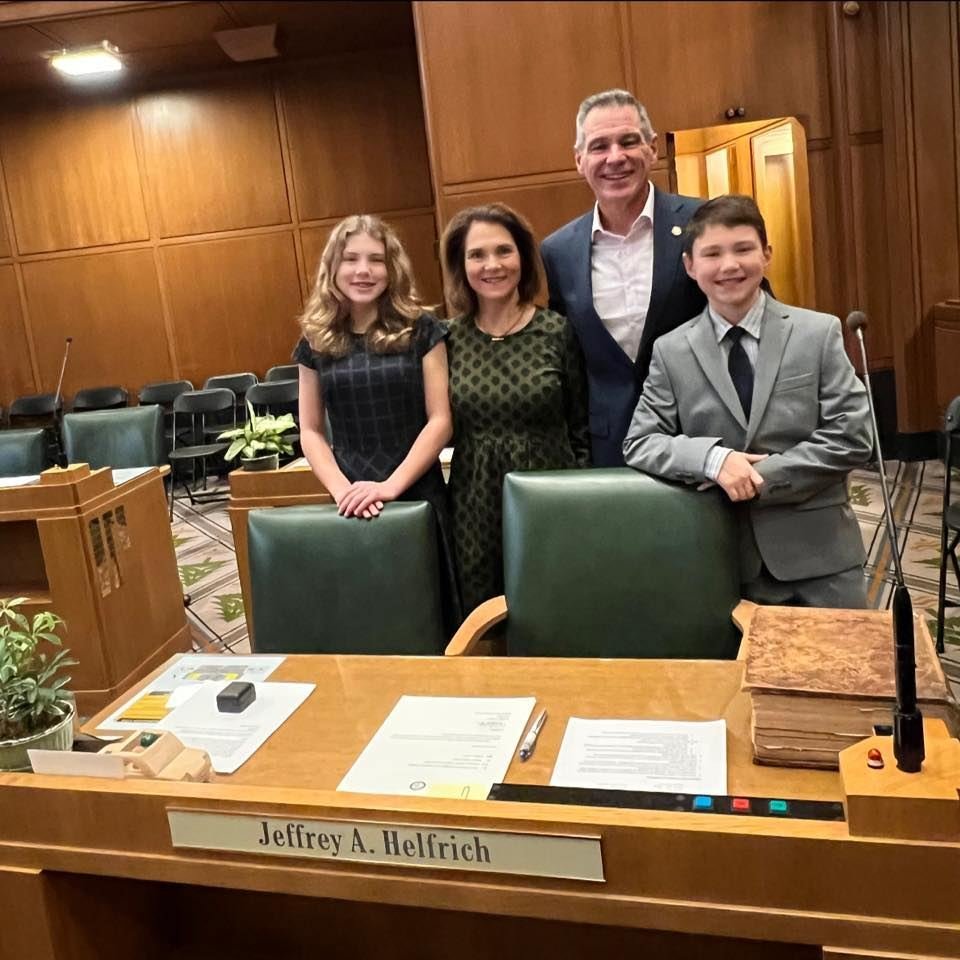
After meeting in an unlikely setting—a local winery, Helfrich and his wife, Shawna, have been together for more than two decades. A casual conversation eventually grew into a relationship. They married in 2009 and are raising two children, Mazzy and Conrad.
“I met Shawna… I was helping somebody out at a winery, and she came walking in, and we just started talking,” Helfrich recalled with a smile. “That’s how it started.”
When the conversation turns to his children, the veteran police officer and legislator sounds less like a public official than a proud father.
“My daughter’s in volleyball and lacrosse,” he said. “My son’s playing football and lacrosse.” Then, with the kind of good-natured humor that surfaces throughout conversation with him, he quickly gives credit for their athletic ability where he believes it belongs. “My wife was a very accomplished athlete… I think my kids get their talent from her.”
Hosford, who lives just down the street from the Helfrich family in Hood River, has watched both Jeff and Shawna away from campaign events and legislative hearings. Their friendship has grown through neighborhood visits, church, and the ordinary interactions that come from living only a block apart.
“I know Shawna very well,” Hosford said. “She’s a very unique woman.” A former collegiate soccer player who later became a naturopathic physician, Shawna is every bit as comfortable outdoors as her husband. She hunts, fishes and spends time in the woods, interests she developed growing up with her father. Hosford laughed while recalling the day Shawna proudly showed her the cougar she had legally shot in self-defense after being stalked during a hunting trip. “She’s a gun club gal,” Hosford said. “She’s a great mom.”
 If the outdoors is a shared passion, parenting appears to be the family’s common priority. Hosford has watched Helfrich coach his son’s football team, attend school activities, and remain involved in his children’s lives despite the demands of serving in Salem.
“He’s a great dad,” she said. “He’s involved in his kids’ school. He’s been a community coach for his son’s football team. Even when you’d think someone wouldn’t have time, he’s out there.”
The same observation surfaces in Salem. During legislative sessions, Helfrich and Sen. Mike McLane share a rented house near the Capitol. The arrangement began as a practical way to avoid constant hotel stays, but it also gave McLane a chance to see his colleague outside the committee rooms and House floor.
There, politics often takes a back seat to everyday routines. McLane laughs when he talks about one unexpected discovery. “He’s a fantastic cook,” he said. “When we’re at home, he usually does the cooking, and so we share a lot of meals together.”
After the death of his father in October 2024, Helfrich stepped away from House leadership in November, deciding that time with his children mattered more than holding a leadership title. It was a deeply personal decision, born from the realization that public service, important as it is, cannot replace the people waiting at home.
“You have an expiration date,” he reflected. “You just don’t know when it is.”
Can our kids afford to stay?
After more than thirty years in Oregon, Jeff Helfrich says one question increasingly concerns him.
“The question that I hear people asking right now is one that really worries me. It’s, ’Can I still afford to stay here?’” he said. “You’ve got businesses asking it. Young families are asking it. Seniors are asking it. And I think increasingly you’re going to see our kids asking the same thing: Can we afford to stay here in Oregon?”
Whether discussing housing, businesses, public safety or transportation, Helfrich often returns to that concern. His focus is not simply on solving today’s problems, but on preserving an Oregon where the next generation can build their lives without feeling they have to leave the state to do it.
That outlook helps explain why he is now seeking the Hoodview-area Senate seat being vacated by Christine Drazan, the 2026 Republican nominee for Oregon Governor.
Seeking the Senate is, in his view, simply a continuation of the public service that began in the Air Force and continued through law enforcement and the Legislature.
“He’s very focused,” said Mike McLane of Helfrich. “He’s a dog on a bone when it comes to getting stuff done. But he has that pragmatism that I love working with… ‘We’re going to do what’s right. We’re going to try to make this effective.’”
In perspective
Nearly every person interviewed for this story described Jeff Helfrich differently.
Neighbor Hosford talked about a neighbor with an unusually strong work ethic who still finds time to coach football, attend his children’s activities and help around the community.
Portland Police Bureau colleague Bill Walker remembered a police supervisor who looked after the people working for him and was always searching for better ways to do the job.
Senator McLane described a legislative colleague who brings humor, perspective, and a calm temperament to an environment where disagreements can easily become heated and personal.
The descriptions are different, but together they paint a remarkably consistent picture.
Long before Jeff Helfrich entered politics, he had already developed a way of looking at the world. Growing up on a Nebraska farm, serving in the Air Force, walking a beat in Portland and raising a family in the Columbia Gorge all reinforced the same instinct: stay calm, work hard, understand the problem, and then try to solve it.
Whether that approach is enough to send him to the Oregon Senate is a decision voters will make in November.
But regardless of the outcome, those closest to him believe his public service has never really been defined by elections or titles.
Instead, they see it in a police officer who wanted students to understand the human cost of addiction, in a community member who volunteered to serve, in a father who stepped away from legislative leadership to spend more time with his children, and in a lawmaker who has spent years looking for common ground where others often see only disagreement.
Perhaps that is why, when debates become heated and the pressure begins to build, Jeff Helfrich has a way of reminding everyone around him to keep things in perspective.
He has many times seen what real life and death emergencies look like. After that, political disagreements don’t seem to loom quite as large. HVN
For more information, Jeff Helfrich’s campaign website can be found at helfrichfororegon.com.