

By MIKE WILEY, Publisher —
The effort to require a vote on higher fuel taxes and increased fees reportedly gains over 150,000 signatures by late November —
During late-November, a strong citizen-led effort reportedly gathered over 150,000 signatures in an effort to refer a large tax increase bill — HB 3991— to Oregon voters. The bill was passed by a special session of the Oregon legislature in September and signed into law by Oregon Governor Tina Kotek on November 7.
As passed by the Democrat-controlled Oregon legislature in a late-summer special session, HB 3991 would raise $4.3 billion over a 10 year period as part of an overall state transportation package. It includes raising the taxes paid at the fuel pump by 15%, to 46¢ per gallon. Oregon is currently among the top 12 highest gas tax states.
It also doubles the payroll wage tax, which is withheld from employee’s paychecks state-wide, increasing it from 0.1% to 0.2%. Part of this tax goes to help fund mass transit like light rail and busses, of which larger metro areas like Portland receive the biggest share.
It also doubles many DMV fees. Vehicle title fee registration increases from $77 to $216, affecting every new and used vehicle purchased. It also increases the passenger vehicle fee from $43 to $85, the utility trailer or light trailer fees from $63 to $105, and moped and motorcycle fees from $44 to $86.
Overall, the increased taxes and fees are estimated to cost $200-$400 per Oregon household per year should HB 3991 make it into law.
The tangled ODOT saga
During the regular Oregon legislative session in the first half of this year, the Democrat-controlled body was unable to come to agreement on funding one of the largest and more important departments of Oregon government, the Oregon Department of Transportation (ODOT).
The efforts to come to agreement on funding included a special committee made up of state Senators and state Representatives from both parties called the Joint Special Session Committee on Transportation Funding. However, committee meetings were often marked by sharp disagreements, dissension within Democrat party ranks, and eventually, shouting and resignations. Frantic efforts were made in the last few days of the session in June, including direct intervention by Governor Tina Kotek. Kotek stated that without new funding, ODOT would face mass layoffs and service cutbacks. Despite this, the legislature still failed to come to agreement and pass a bill before the constitutionally mandated end of the session in June, leaving ODOT temporarily without budgetary funds.
This led to Gov. Kotek calling legislators back for a Special Session over Labor Day weekend to finalize a bill for ODOT, hoping to encourage the legislators into quick passage. However, the legislature, still divided and with a key member, Gresham State Senator Chris Gorsek, unable to attend for health reasons, did not pass a final bill for over a month. They finally passed HB 3991, which included the large tax hikes, on Sept. 29, a month after the special session began.
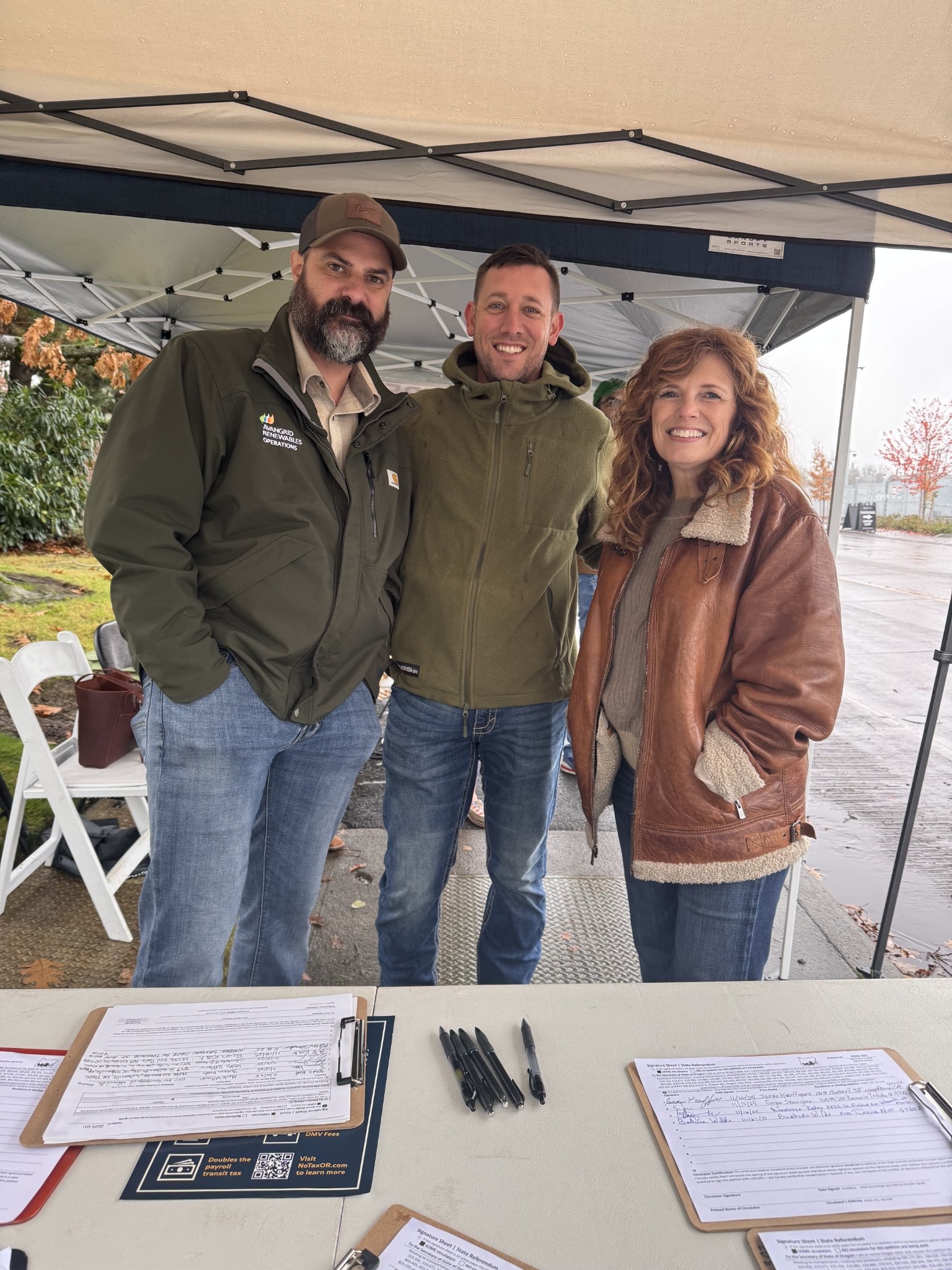
Referendum seeks to overturn tax and fee hikes
Oregon’s Initiative, Referendum, and Recall system gives Oregon citizens a chance to pass judgment on a bill that has been approved by the legislature. After the close of a legislative session, including a special session, the Oregon Constitution gives citizens 90 days to gather enough signatures in a Referendum effort to refer a bill passed by the legislature to a vote of the people. This is designed to be a check by the people on overreach by the legislature.
To qualify a referral of the transportation tax increases for the ballot, the referendum sponsors must gather 78,116 valid signatures, or 4% of the total vote for governor in the most recent election.
According to reports, as of late November, the referendum—led by “No Tax Oregon” and chief petitioners Rep. Ed Diehl (R), Sen. Bruce Starr (R), and Jason Williams of the Oregon Taxpayers Association—has surged past the signature threshold with over 150,000 raw signatures collected.
Given the raw number of signatures gathered, the referendum will likely qualify for the ballot. However, supporters want the strong signature gathering to continue to the December 30th deadline, as in recent years signature verification has faced stricter scrutiny from Oregon Secretaries of State.
Recent updates
The Oregon Taxpayer Association website, Oregon Catalyst (oregoncatalyst.com), updated the progress of the referendum in late November. According to the website:
• As of Tuesday, Nov. 25 midday, the estimated number of signatures collected was above 150,000, a little over one week since the effort kicked off. On Saturday, November 22 alone, No Tax Oregon volunteers collected more than 25,000 signatures during the Sign Across Oregon event. Combining Sunday’s total, this marks the second weekend in a row that more than 40,000 signatures were gathered.
• Representative Ed Diehl, one of the three chief petitioners on the referendum, emphasized the unprecedented nature of the effort:
“We are making Oregon history. This is the largest volunteer signature effort the state has seen in years—possibly ever. People aren’t just willing to sign; they’re seeking us out. Oregonians want the right to vote on these taxes and fees, and they know Salem is not representing their interests. They voiced their opposition repeatedly through the regular session and again during the emergency session, but the Governor and the Democrat majority ignored them and rammed this bill through anyway. At some point, the people have to rise up and say ‘no more,’ and that’s exactly what we’re seeing with this movement,” said Diehl.
• In talking about the policy implications, Senate Republican Leader Bruce Starr, also a chief petitioner, commented on the negotiation process and the need to come back to the table.
“Republicans offered real alternatives that maintained our roads and bridges without massive new taxes. We stand with Oregonians who want the opportunity to vote on the Governor’s gas tax increase. Oregonians want state government to prioritize tax dollars, not just always ask for more.”
• On the impact of the gas tax on ordinary Oregonians, Co-Chief Petitioner Jason Williams, Founder of Taxpayers Association of Oregon said:
“The overwhelming response to this petition is a result of the fact that Oregonians know that the cost of this tax is too much. Many families will be paying $300 to $600 more in higher costs because of this enormous tax increase. Seniors on a limited income and the unemployed will be hit with a cost that they cannot afford.”
No Tax Oregon will continue to gather signatures into December and expects to at least double its initial goal of 100,000 signatures, Oregon Catalyst reported.
Kotek maneuvering?
It was vital that signature gatherers had a fast start. Oregon’s famous and first-in-the-nation Initiative, Referendum, and Recall system gives only 90 days after a bill has been approved by the legislature for signatures to be gathered to refer it to voters.
However, due to a quirk in the laws, while the clock to gather the necessary signatures starts the day after the legislature passes a bill and closes the session, signature gathering to refer bills to voters cannot begin until the governor signs the bill, making it law. State law allows the governor to take as many as 30 business days to sign a bill. Typically, this has not been an issue, as it normal for the governor to sign the law as soon as practical after it has been passed.
However, Governor Kotek, an advocate of the tax-hiking transportation bill, delayed signing the bill until near the last possible day, Friday, Nov. 7, giving supporters of the referendum less than two months to gather the necessary signatures.
Drazan criticizes
State Sen. Christine Drazan, who is also a declared Republican candidate for governor in 2026, was critical of the governor’s delay in signing the bill.
Drazan told KATU: “This is her signature tax increase, which she said was an absolute emergency. She brought us into session over Labor Day weekend to get this done, and she signed the bill, you know, in November, and we all know that she would have probably signed it right away if it weren’t for the likelihood that this will get referred to Oregon voters,” Drazan said.
Still, the proponents of the referendum effort used the time between bill passage and the governor’s signature to organize and plan their signature gathering efforts, resulting in an astounding number of signature being gathered by Dec. 1, apparently off-setting the effects of Kotek’s delay in signing the bill.
Taxes suspended
Verification of the signatures will begin once the signature sheets are turned in to the Oregon Secretary of State, likely sometime in late December. If enough signatures are verified, the referendum will appear next year on the Nov. 3, 2026, ballot.
The HB 3991 tax hikes were scheduled to go into effect January 1, 2026. However, those increases are suspended while the referendum effort is continuing. If voters decide to reject the transportation bill tax hikes in November, 2026, they will not go into effect at all.
Referendum co-leader Jason Williams of Oregon Taxpayer Association urged Oregonians to get involved in the signature gathering effort. “Anyone who wants to participate in the signature gathering effort should go to stopthegastax.com. We need to gather as many signatures as possible to allow a large buffer,” said Williams.
Poll shows tax opposition
A late-October survey of 500 Oregon voters by Riley Research Associates showed that increases in gas taxes, vehicle registration fees, title fee increases, electric vehicle fee increases, and an employer mass transit fee increase are all opposed by likely voters.
A large majority of Oregon voters said that if a measure was on the ballot to overturn the tax increases, they would vote to do so. According to the survey:
• 67% said they would vote “no” to repeal the taxes
• 21% said they would vote “yes” to keep the taxes
• 13% were undecided.
If the referendum qualifies for the ballot, the vote will be at the general election late next year. HVN